Machiavelli DELUXE
Seven political acts, Fortuna and a crisis council. What kind of state will your decisions create?


One question. A few ideas. Occasionally, an entire system.


Serious questions. Suspiciously enjoyable learning.
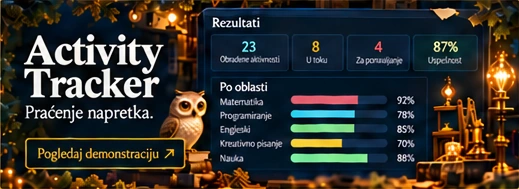
Tracking learning progress.


Everything fits. Almost.
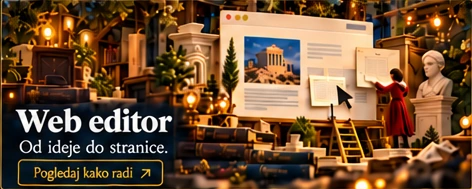
From an idea to a web page.


A small world of big discoveries.


The next idea is already taking shape.
Two ways to explore ideas through decisions. Choose a simulation; both are available in Serbian and English.
Seven political acts, Fortuna and a crisis council. What kind of state will your decisions create?
A convincing argument — or a clever trick? Enter a debate where the rules are frequently bent.
Public guest demos · no login · no results sent to school records.
“Let me try just one more thing.”
I’m Aleksandra. I just wanted my lessons to be more engaging.
I wanted students to be more than an audience: to explore, experiment, connect ideas, make mistakes — and reconsider.
That is how interactive lessons, activities, games and simulations began. Then I needed a way to see how students were progressing. Then a tool to edit materials more easily. And a few more things followed.
This is where those ideas come together: some are already used in the classroom, some are still on my workbench, and others are only beginning to emerge from my notebook.
I am most interested in where teaching, creativity and technology meet. And in that familiar question: “What if we tried it this way?”
I wanted more engaging lessons: lessons where students ask questions, investigate, connect ideas and challenge assumptions.
These materials grew out of everyday teaching with secondary-school students who bring different interests, backgrounds and ways of learning. They are an attempt to make philosophy, logic and other humanities and social-science subjects worth thinking about beyond the classroom.
I am not writing a new textbook. I create teaching materials that complement lessons and offer different routes to understanding. Simulations, everyday examples, humour and metaphors help students approach complex ideas. Original texts, close reading and careful study of theories remain irreplaceable.
Accessibility must not come at the expense of accuracy or meaning. I want students to understand not only what a philosopher thought, but what question motivated them, how they defended their answers and what we might ask them today.
I want students to ask questions, examine arguments and develop their own thinking — while remaining willing to question even their own views.
I do not see philosophy as sterile theoretical knowledge. I want my students to discover how deeply it connects with life.
Some ideas do not have buttons yet. When they do, you will find them here.
The next idea is already taking shape.
For conversations about teaching, digital tools, workshops and possible collaborations.
aleksandraedtech@gmail.com ↗